TL;DR Quick Answers
Blower Motor Replacement Cost
Blower motor replacement cost typically runs $300 to $1,500 total, parts and labor combined. The range tracks motor type: PSC motors fall at the lower end, while variable-speed (ECM) motors run higher because the motor and control module often ship as one programmed assembly. That one design detail drives most of the sticker shock we see.
Total range: $300 to $1,500 (parts and labor combined)
PSC (single-speed) motors: $300 to $900
Variable-speed (ECM) motors: $600 to $1,500
Labor: $150 to $450 depending on motor type and access
Biggest cost driver: whether the motor and control module ship as one programmed assembly
Top Takeaways
A variable-speed (ECM) blower motor replacement typically runs $600 to $1,500 total, parts and labor combined.
The biggest reason ECM replacements cost more than PSC is that the motor and its electronic control module often ship as one programmed assembly.
Correct diagnosis matters more than any other single cost factor on this job. A wrong call has the homeowner paying for the motor twice.
Manufacturer warranties usually cover the motor itself, but labor is almost always out of pocket on top of that.
Consistent filter changes are the cheapest way to extend a blower motor's working life.
What a Variable-Speed Blower Motor Is (and Why It Costs More)
A variable-speed blower motor is an ECM, short for electronically commutated motor. It's a brushless DC design with a built-in electronic controller that adjusts speed continuously to match what the furnace needs as conditions change. The controller is the reason these motors run quieter, ramp up gradually instead of slamming on at full power, and draw a fraction of the wattage that older single-speed PSC motors pull. It's also the reason replacement quotes run higher.
The motor and the control module are tightly integrated. Some manufacturers sell them as one assembly, often pre-programmed for a specific furnace model. That means a generic replacement usually isn't an option when the motor fails. The U.S. Department of Energy's Fan Efficiency Rating standard, which took effect on July 3, 2019, pushed manufacturers toward these lower-wattage motors across the residential furnace market. Most homes built or upgraded since then are running one.
Typical Replacement Cost Range
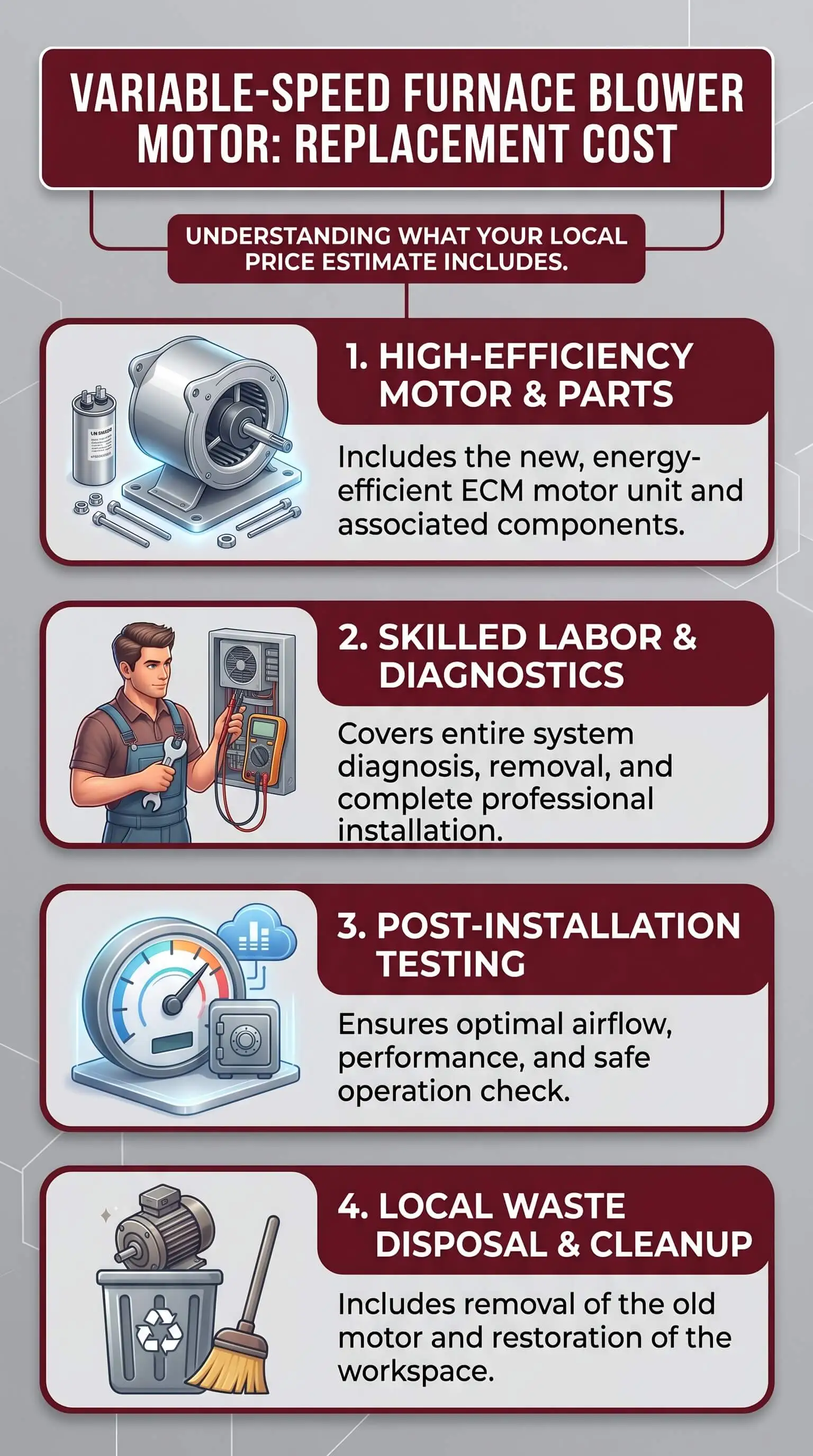
Most variable-speed (ECM) blower motor replacements land somewhere between $600 and $1,500 total, parts and labor combined. The motor or motor-and-module assembly itself runs $300 to $1,100, depending on the brand, whether the part is OEM, and whether the controller is integrated. Labor adds another $200 to $450 for a job that usually takes one to three hours, with rates varying by region. Emergency or after-hours service tacks on another $100 to $250.
Those are typical ranges, not guarantees. A straightforward swap on an accessible mid-priced furnace can come in at the lower end. A premium variable-speed unit tucked into a tight attic, with a motor sold only as a programmed assembly, will push toward the upper end.
What Drives Variable-Speed Replacement Cost Higher
A quote that feels higher than expected usually traces back to a few specific drivers. We see these most often on variable-speed jobs:
Motor-and-module assemblies. Many ECM motors aren't sold as a bare motor. The control module is integrated, and replacement means buying the whole assembly, usually pre-programmed for the furnace model.
OEM matching. Mid-range and premium variable-speed systems often require an original-equipment replacement to preserve warranty terms and let the control logic talk properly to the furnace's main board.
Programming time. Some ECM modules ship blank and need to be programmed on-site to match the system. That's not a fast step.
Access. Attic furnaces, tight mechanical closets, and packed utility rooms add labor time to every step of the job.
Related parts. Worn wiring harnesses, a faulty control board pretending to be a motor problem, or a dirty blower wheel uncovered during disassembly each add work.
Regional rates. Hourly labor costs vary considerably between markets and seasons.
Labor vs. Parts: What You're Actually Paying For
A proper ECM replacement is more involved than a part swap. The labor line on the invoice pays for diagnosis, safe disassembly, install, and verification.
Diagnosis is the step homeowners undervalue most. A weak control board, a failed capacitor on a related circuit, or static pressure pushing the motor past its design envelope can all look like a dead motor on first inspection. Get that wrong and the homeowner pays for a new motor only to watch the same symptoms come back two weeks later.
Once the technician confirms the motor is the actual problem, they isolate power, remove the old motor and wiring, mount and terminate the new assembly, and test the system through both heating and cooling calls to confirm airflow hits spec with a top furnace filter in place. A low quote that skips testing the filter’s role in airflow usually turns into a follow-up visit.
Warranty Coverage Most Homeowners Get Wrong
Two warranties usually apply, and they cover different things. The manufacturer parts warranty covers a defective motor, but only if the homeowner registered the system after installation. Many never did. The installer's labor warranty covers the work itself for a separate period, usually one to two years, and varies by company. Understanding the basics оf aіr conditioning also helps homeowners see why parts coverage and labor coverage are separate when blower motor performance affects the entire HVAC system.
The biggest surprise lands at the bottom of the invoice. Even when the part is fully covered, the labor isn't. We've watched homeowners save several hundred dollars on the motor itself and still pay the full labor bill out of pocket.
Before approving the work, ask:
Is this motor covered under my manufacturer warranty?
If it's covered, am I still paying for labor separately?
Was my system registered, and can you confirm?
Will your team handle the warranty claim, or is that on me?
Money-Saving Strategies That Don't Cut Corners
A few practical moves can lower a variable-speed motor replacement bill without setting up the next failure.
Insist on a thorough diagnosis. Ask the technician to explain which tests pointed to the motor specifically. The right diagnosis saves more money than any other single step on this job.
Fix the root cause. Many ECM failures trace back to restricted airflow from a severely clogged filter, a dirty blower wheel, or blocked return registers. Get that handled during the same visit. Otherwise the new motor inherits the same stress that killed the old one.
Skip emergency rates when you can. If the system is safe to leave off overnight, scheduled service usually costs less.
Consider the system's age. If the furnace is past 12 to 15 years and has already needed other major repairs, comparing the motor cost against a full system replacement is worth doing.
Don't skip filter changes. A clean filter is the single cheapest thing a homeowner can do to extend blower motor life.
For a deeper look at cost factors across both PSC and ECM motors, this complete blower motor replacement cost guide walks through every variable in the same kind of detail.
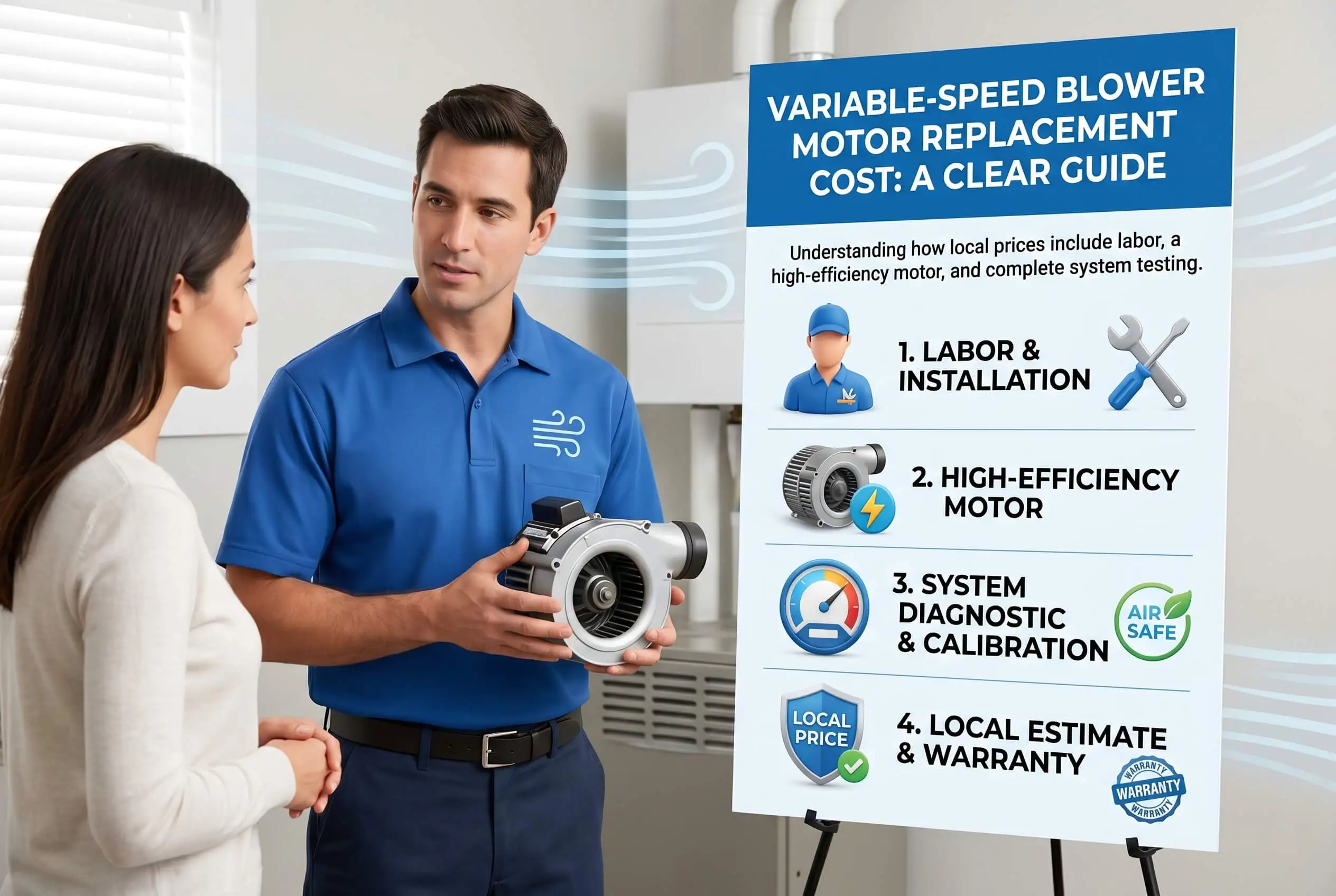
"The biggest mistake we see on a variable-speed motor call is the homeowner approving the work before the technician explains what tests actually pointed to the motor. On ECM systems, a failing control board or a static pressure problem can mimic motor failure exactly. Ten extra minutes on diagnosis up front saves an entire repair bill more often than people realize."
7 Essential Resources
References we point homeowners to when they want to research this themselves:
DOE Building America Solution Center: ECM Air Handler Fans. Federal technical resource that lays out the wattage differences between PSC and ECM motors. basc.pnnl.gov/resource-guides/ecm-air-handler-fans
ENERGY STAR Furnaces Key Product Criteria. The official ECM definition and qualifying efficiency criteria for residential furnaces. energystar.gov/products/furnaces/key_product_criteria
DOE: Variable-Speed, Low-Cost Motor for Residential HVAC Systems. Overview of variable-speed motor efficiency in HVAC applications, published by the Department of Energy. energy.gov/cmei/ito/variable-speed-low-cost-motor-residential-hvac-systems
DOE Building America Case Study: Variable-Speed Furnace Fan Motors. Measured fan-power reductions from variable-speed motor retrofits across eight tested homes. energy.gov/sites/prod/files/2014/02/f7/case_study_variablespeed_furnacemotor.pdf
DOE: Motor Energy Savings Potential Report. Federal analysis of residential furnace fan motor consumption and savings opportunities. energy.gov/eere/buildings/articles/motor-energy-savings-potential-report
Wikipedia: Furnace (Central Heating). Background on residential furnace types, efficiency categories, and forced-air design. en.wikipedia.org/wiki/Furnace_(central_heating)
Furnace Blower Motor Replacement Cost Guide. Detailed breakdown of PSC vs. ECM cost factors, warranty mechanics, and labor pricing. filterbuy.com/resources/furnaces/furnace-knowledge/furnace-blower-motor-replacement-cost-factors-warranty-labor-parts-psc-vs-ecm-savings
3 Statistics
PSC motors typically draw 500 to 550 watts during heating and cooling operation, while ECMs can run on as little as 80 watts thanks to variable-speed control. Source: DOE Building America Solution Center
The DOE Fan Efficiency Rating (FER) standard required furnace fan electrical consumption reductions of roughly 40 percent, taking effect on July 3, 2019. Source: ENERGY STAR Furnace Program Requirements
DOE-published case studies of variable-speed motor retrofits documented average fan-power reductions of 23 percent in heating mode and 38 percent in cooling mode across eight tested homes. Source: DOE Building America Case Study
Final Thoughts and Opinion
Variable-speed motors cost more to replace because they're more sophisticated parts installed in more demanding systems. There's no shortcut around that. The savings homeowners actually capture from HVAC repair come from three places: getting the diagnosis right the first time, fixing the airflow conditions that stressed the motor, and asking the warranty questions before approving the work. Done right, a variable-speed motor pays its higher upfront cost back over the rest of the furnace's life through lower electricity bills and quieter operation.
Frequently Asked Questions
How much does a variable-speed furnace blower motor cost to replace?
Most replacements land between $600 and $1,500 total for parts and labor. The motor or motor-and-module assembly itself usually runs $300 to $1,100, with labor adding $200 to $450 depending on access and regional rates.
Why is a variable-speed motor more expensive than a PSC motor?
Variable-speed motors integrate the motor and an electronic control module, often as one programmed assembly. The part itself costs more, and matching it correctly to the furnace takes more skill and sometimes on-site programming.
Can a variable-speed ECM motor be replaced with a cheaper PSC motor?
Usually not. The furnace's control board and airflow design assume an ECM is in place, and forcing a PSC into the system creates comfort and efficiency problems even when it physically fits. A like-for-like replacement is almost always the right call.
Are aftermarket ECM motors as reliable as OEM replacements?
Quality varies considerably. We've found that for premium variable-speed systems, OEM parts protect both warranty status and system performance. Aftermarket replacements can work on older or standard-tier units when they're properly matched.
Does a dirty air filter shorten ECM motor life?
It can. A clogged filter restricts airflow, raises static pressure, and forces the motor and its controller to work harder against resistance. Heat builds up in the control electronics, which is where ECM failures often start.
Will my furnace warranty cover the blower motor?
The motor itself is usually covered under the manufacturer's parts warranty, as long as the homeowner registered the system after installation. Labor is a separate matter, typically covered by the installer's labor warranty for one to two years, then out of pocket.
How long should a variable-speed blower motor last?
A well-maintained variable-speed motor commonly lasts 15 to 20 years, which is roughly the lifespan of the furnace itself. Early failures usually trace back to restricted airflow or moisture damage to the electronics.
Know the Cost Before You Approve the Quote
Walking into a variable-speed motor replacement conversation already knowing the fair price range is the best protection a homeowner has against overpaying. For a deeper breakdown of every cost driver on furnace blower motor replacement, read the complete cost guide here.
In an article about How Much Does It Cost to Replace a Variable-Speed Furnace Blower Motor?, it makes sense to connect the repair cost discussion back to airflow maintenance, because a variable-speed blower motor works harder when the system is restricted by a dirty or poorly fitted filter. Homeowners comparing replacement costs can also look at options like 20x25x4 furnace filters, 20x23x1 HVAC air filters, and 24x24x4 furnace filters to understand how the right filter size and MERV rating can support cleaner airflow, reduce unnecessary strain on the blower assembly, and help protect the investment after a costly variable-speed furnace blower motor replacement.