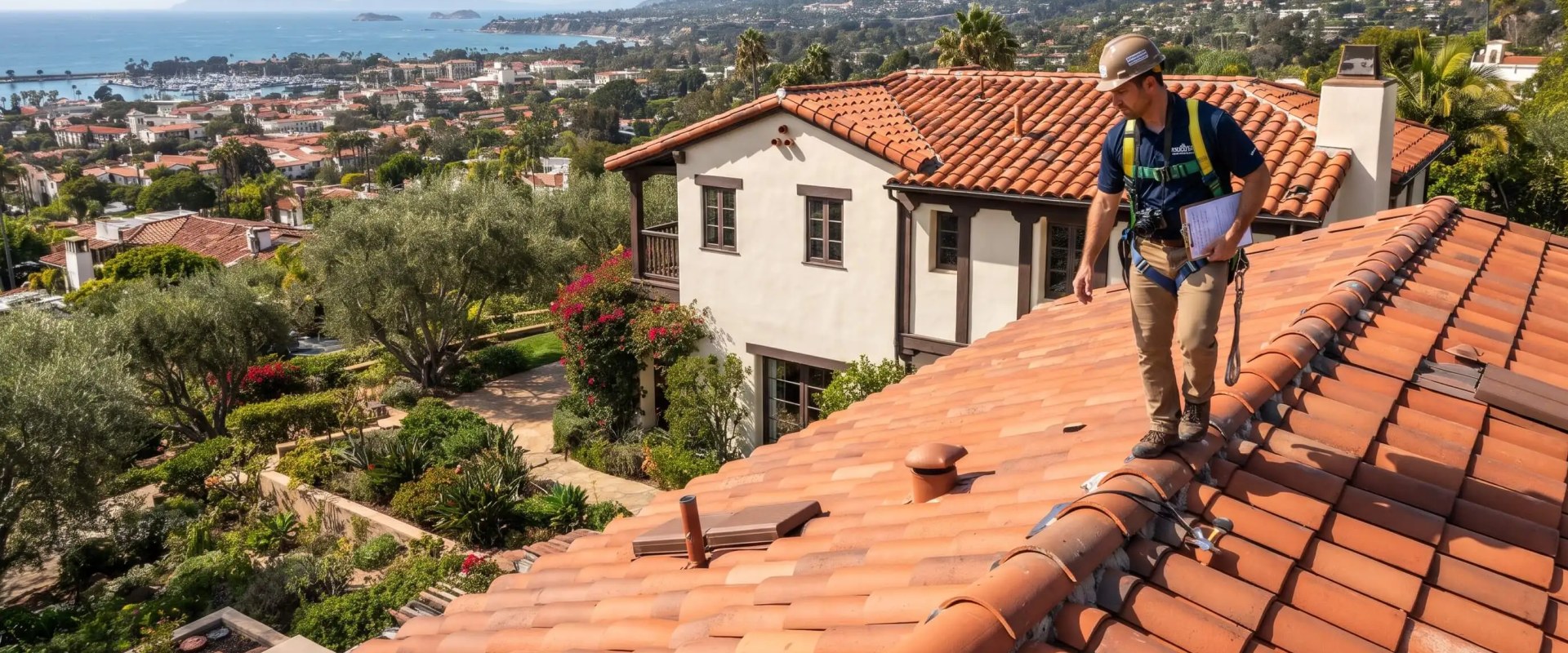
Your buyer's inspector is going to look at your roof either way. What you control is whether you see the findings first. For most Santa Barbara sellers, a roof inspection before listing is worth scheduling, because it puts the roof's condition in your hands before a repair request lands in the middle of escrow.
How much it matters depends on the house. A newer roof with permits and a maintenance record may only need a quick look. An older clay tile roof on a windy hillside, or a home in a fire hazard area, usually has a longer story to tell, and that's where a roof inspection in Santa Barbara tends to change how a sale goes.
We've inspected, repaired, and replaced roofs across Santa Barbara County since 1996. Sellers who call us before they list go into negotiations with photos, written findings, and a plan. Sellers who wait often hear about their roof for the first time in a buyer's repair request, with a few days left on the contingency and not much room to compare bids.
TL;DR Quick Answers
Roof Inspection Santa Barbara
A roof inspection in Santa Barbara is an on-site evaluation by a licensed roofer that ends in photos and written findings. A good report separates what needs attention now from what you can maintain or monitor.
Who books one? Home sellers before listing, buyers in escrow, owners documenting a roof for insurance, and anyone with an older roof nobody has checked lately.
What the roofer checks. Tile, shingle, flat, slate, or synthetic roofing, plus flashing, valleys, vents, chimneys, drainage, earlier repairs, and signs of moisture.
How long it takes. Most homes take 60 to 90 minutes on site. The written report usually follows in 2 to 3 business days.
What it costs. A formal inspection is a paid service, quoted per property. Quality Roofing prices any recommended repairs separately, for free.
What Santa Barbara roofs tend to show. Aging underlayment under clay tile that still looks fine, salt-air wear on flashing, leaf-clogged valleys, and buyer or insurer questions in fire hazard zones.
Timing for sellers. Book 4 to 8 weeks before you list so repairs and disclosures are done before photos.
Not every finding means the roof needs replacing. Most reports point to maintenance or a few targeted repairs.
Top Takeaways
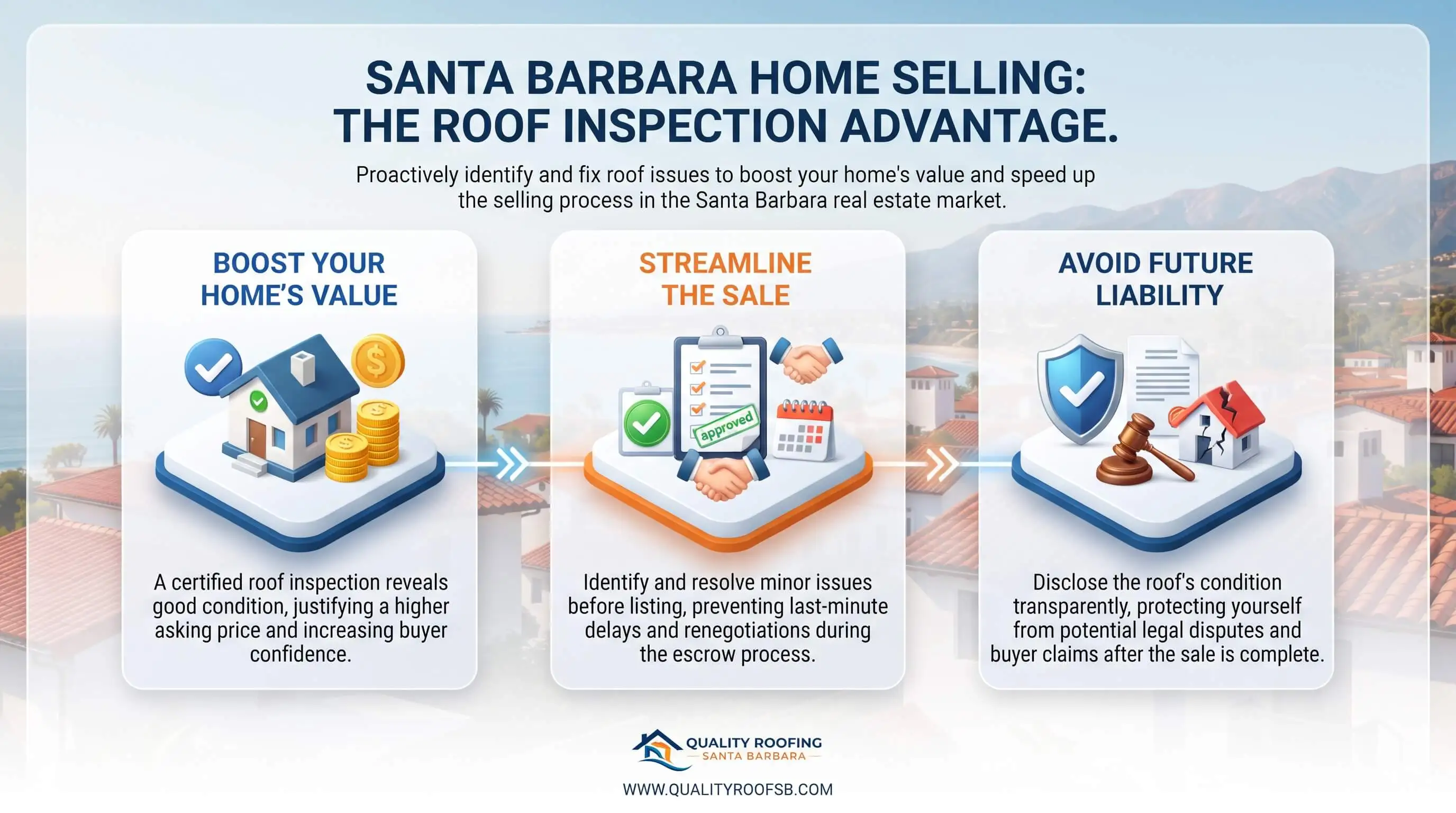
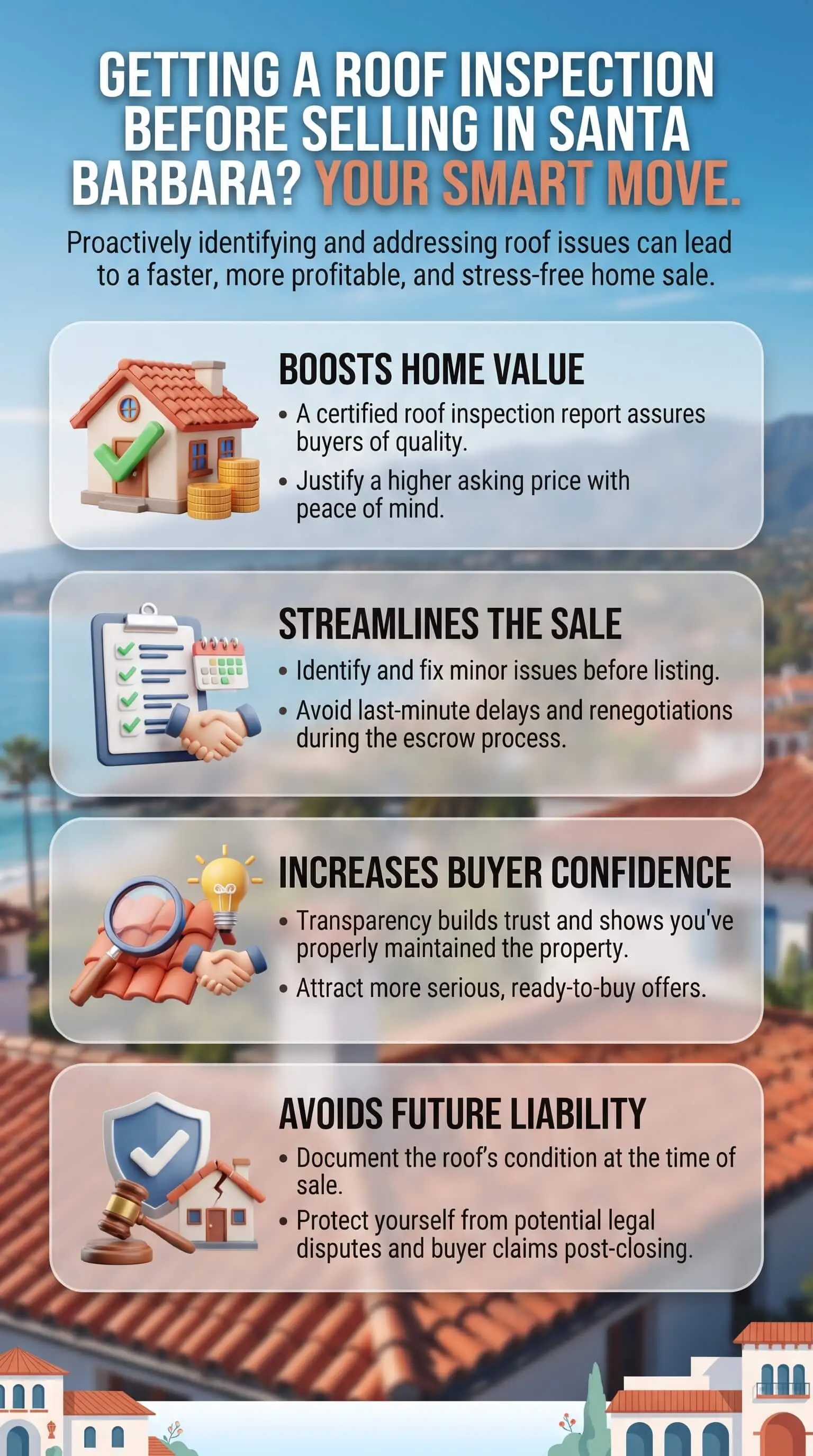
Inspecting before you list lets you repair, price in, or disclose roof issues on your schedule instead of the buyer's.
A general home inspector may only view the roof from the ground or the eaves, while a roofer documents it up close with photos and written priorities.
Tile roofs are where pre-listing inspections pay off most in Santa Barbara, because underlayment can wear out under tile that still looks fine.
Book 4 to 8 weeks ahead. The visit takes 60 to 90 minutes and the report arrives in 2 to 3 business days, which leaves time for repairs.
Why the Roof Becomes the Sticking Point in Santa Barbara Home Sales
Buyers know the roof is one of the most expensive parts of a house to replace. So when an inspection report mentions it, that's usually where the negotiation starts.
Here's how it tends to unfold when nobody has looked at the roof before escrow:
The buyer's home inspector notes cracked tiles or tired flashing and recommends a licensed roofer take a closer look.
The buyer asks for a repair, a credit, or a lower price based on the worst-case reading.
The seller has a few days to find a roofer, book a visit, and respond.
Everyone ends up deciding against the clock, with less information than they'd like.
A general home inspection covers the whole house in one visit, and it's useful. It just isn't built to give the roof the close, photo-documented look a roofing contractor provides. A professional specializing in roofing Santa Barbara homes can provide that detailed assessment. Plenty of escrow surprises start in that gap.
Pre-Listing vs. Buyer-Ordered Roof Inspections
The difference comes down to who sets the timeline and who decides what happens with the findings.
Pre-listing roof inspection
You schedule it before the home goes on the market
You have several weeks to review the findings and price any repairs
You choose the roofer
You can repair, price in, or disclose anything it finds upfront
Escrow tends to go more quietly
Buyer-ordered roof inspection
The buyer schedules it during escrow, and you usually get a few days to respond
The buyer chooses the roofer
The findings become the basis for repair or credit requests
Delays and renegotiation are more likely
Buyers still see everything an inspection turns up. You simply see it first, while there's still time to act on it.
What a Roof Inspection in Santa Barbara Should Cover
A professional roof inspection documents the roof's accessible surfaces, components, and visible condition, then sorts what it finds into what needs attention now and what can be maintained or monitored.
On a thorough inspection, the roofer looks at:
Tile, shingles, or other roofing materials
Flashing, valleys, edges, and roof transitions
Vents, skylights, chimneys, and other penetrations
Gutters, drains, scuppers, and drainage paths
Cracked, displaced, missing, or deteriorated materials
Visible signs of moisture intrusion or previous leaks
Sealants, fasteners, and earlier repairs
Conditions that may affect how the roof performs from here
Most residential inspections take 60 to 90 minutes on site. Afterward you should get a written report with photographs, a summary of the roof's general condition, and clear priorities. Reports typically arrive within 2 to 3 business days, so build that into your listing calendar.
If you want a photo-documented record before you list, you can schedule a roof inspection in Santa Barbara with a licensed local roofer. On steep or fragile roofs, ask whether a drone inspection makes sense. It captures the surface without anyone walking on brittle tile.
Local Conditions That Show Up on Santa Barbara Roof Reports
Santa Barbara roofs age in ways that are hard to judge from the sidewalk. On homes headed to market, these come up most often in our reports.
Clay and concrete tile over aging underlayment. Tile can look fine for decades while the underlayment beneath it wears out. The tile sheds most of the water, but the underlayment is what keeps the house dry.
Cracked, slipped, or broken tiles. Foot traffic from old repairs, solar installs, or holiday lighting often leaves damage you can't see from the ground.
Worn flashing and sealant. Coastal moisture and salt air are hard on metal flashing and on the sealant around vents, chimneys, and walls.
Debris in valleys and gutters. Oak and sycamore leaves collect in valleys and slow the water down. A lot of leaks start right there.
Ponding on flat and low-slope sections. We see it often on additions and mid-century homes.
Fire-related questions. Much of Santa Barbara, Montecito, and the foothills sit in mapped fire hazard areas, and buyers and insurers ask about roof materials and condition more than they used to.
Not every finding means the roof needs to be replaced. Most of these items turn out to be routine repairs or maintenance once someone has actually identified them.
Disclosure, Insurance, and Escrow: How a Report Helps
California sellers have to disclose known material defects on the Transfer Disclosure Statement, and known roof problems are part of that. A pre-listing report helps you complete the disclosure accurately and shows buyers what the inspection found and what you did about it.
Insurance is the other pressure point. California's homeowners insurance market has tightened, and a buyer's insurer may ask about roof age and condition before it issues a policy. A recent report from a licensed roofer, with photos, gives your buyer something concrete to hand over. That helps keep the closing date where it is.
For the legal specifics of disclosure, check with your real estate agent or a real estate attorney. Our part is documenting the roof clearly and accurately.
Inspection, Free Estimate, or Roof Certification?
People tend to use these terms interchangeably, even though each one answers a different question.
Formal roof inspection. It tells you what condition the roof is in right now. Sellers, buyers, and anyone documenting a roof for insurance use it most. You get photos and a written condition report with priorities, and it's a paid service.
Free roof estimate. It prices the work the inspection recommends, which makes it the right fit for a known leak, visible damage, or a planned replacement. You get the scope and the price.
Roof certification. It states that the roof is expected to perform for a set period, and roofers often issue it only after any needed repairs. Most sellers need one only when a buyer, lender, or insurer asks. Cost varies by roofer and by the roof's condition.
For most sellers, the inspection comes first. If it recommends repairs, a separate repair estimate can follow, and we don't charge for those.
What to Do If the Inspection Finds Problems
A report full of findings still leaves you with options. Sellers usually pick one of four.
Repair before listing. This works best for clear, contained items like cracked tiles, worn flashing, or resealing around penetrations.
Offer a credit. Useful when time is short or the buyer would rather hire their own contractor.
Adjust the price. Reasonable when the roof is near the end of its service life and both sides know it.
Disclose and sell as-is. This works when the report goes out upfront and the price already reflects the roof's condition.
Whichever route you take, a written report and an itemized estimate let you decide with actual numbers in front of you.
Where the Roof and HVAC Inspections Overlap
Roof and HVAC findings often land on the same page of an inspection report. Rooftop condensers, vents and flues that pass through the roof, and attic ventilation all sit where the two systems meet, and every one of those penetrations depends on flashing and sealant holding up. If you're also getting your heating and cooling system ready for a sale, documented service helps there too. This guide on scheduling an HVAC tune-up before a home sale or inspection covers what to ask for.
When to Schedule a Roof Inspection Before Listing
Book it about 4 to 8 weeks before you plan to list. That leaves room for the visit, the 2 to 3 business day report, any repairs, and updated disclosures before the photographer shows up.
The pre-listing sequence we usually recommend:
Book the inspection and tell us your listing date.
Read through the photo report and its priorities.
Decide, item by item, whether to repair, price in, or disclose.
Finish any repairs and keep the invoices and photos.
Add the report and repair records to your disclosure package.
List the home with documentation ready for buyers and their insurers.
If you're listing after the rainy season starts, book sooner than that. Roofers' calendars fill quickly after the first storms.
"Most of the Santa Barbara roofs we inspect before a sale look fine from the street, and that's exactly what catches sellers off guard. A clay tile roof can hold its color and shape for decades while the underlayment under it is close to done. We find it on the Riviera, in Montecito, out in Goleta. The sellers who call us before they list see it in photos, decide what to fix, and hand buyers a clear report. The ones who wait usually hear about it from a buyer's repair request with three days left on the clock. Same roof, same findings. What changes is who's holding the information when the conversation starts. After 30 years and more than 10,000 roofs, our advice is the same as it's always been. Know your roof's condition before anyone else does."
Essential Resources
1. Check Your Roofer's License Before Anyone Climbs a Ladder
Contractors State License Board (CSLB), Check a License. We send every seller here first. Any roofer you hire for a pre-listing inspection or repair should hold an active California license, and this lookup shows license status and complaint history in about a minute. Buyers and agents look roofers up too, so it helps to hire one whose record is easy to confirm. https://www.cslb.ca.gov/OnlineServices/CheckLicenseII/CheckLicense.aspx
2. Read What California Asks Sellers to Disclose
California Legislative Information, Civil Code Section 1102.6 (Real Estate Transfer Disclosure Statement). This is the statute behind the disclosure form California sellers fill out. A pre-listing roof report does the most good when it lines up with what the form actually asks, so we suggest reading it alongside your agent's guidance. https://leginfo.legislature.ca.gov/faces/codes_displaySection.xhtml?lawCode=CIV§ionNum=1102.6
3. Look Up Your Home's Fire Hazard Severity Zone
CAL FIRE Office of the State Fire Marshal, Fire Hazard Severity Zones. Large parts of the Santa Barbara foothills and Montecito fall inside mapped fire hazard zones, and buyers ask about roof coverings because of it. Type in your address and the viewer shows your zone. If you know it before you list, the question won't catch you flat-footed. https://osfm.fire.ca.gov/what-we-do/community-wildfire-preparedness-and-mitigation/fire-hazard-severity-zones
4. See Why Insurers Pay Attention to Roof Condition
California Department of Insurance, Homeowners Insurance Guide. The state's guide notes that wear and tear usually isn't covered by a homeowners policy, and it points people to the California FAIR Plan when standard coverage is hard to find. That's why insurers look closely at roofs. A documented roof makes your buyer's conversation with their insurer a lot easier. https://www.insurance.ca.gov/01-consumers/105-type/95-guides/upload/Homeowners-Insurance-Updated-121924.pdf
5. Pull Your Roof's Permit History
City of Santa Barbara Community Development, Property Records & Archives. Buyers and their agents can look up permit history, and a roof someone replaced without a finaled permit tends to raise questions in escrow. Check your street file for past roofing permits so the paperwork matches the roof on the house. Homes outside city limits go through the County of Santa Barbara instead. https://santabarbaraca.gov/services/construction-land-development/view-property-records-archives
6. Know What a General Home Inspection Leaves Out
InterNACHI, Home Inspection Standards of Practice. Section 3.1 lets a general home inspector evaluate the roof from ground level or the eaves. It also says the inspector doesn't have to walk the roof, predict how long it will last, or certify it. Home inspectors do valuable work, and this is simply the reason a roofer's inspection adds information the general report was never designed to cover. https://www.nachi.org/sop.htm
7. Confirm Industry Membership When Comparing Roofers
National Roofing Contractors Association (NRCA), Member Directory. NRCA is the roofing industry's national trade association, and Quality Roofing is a member. Its directory lets you confirm whether a contractor belongs. Pair it with the CSLB lookup and you'll have an independent read on who you're hiring before the inspection is booked. https://www.nrca.net/Members
Supporting Statistics
These numbers line up with what we see on Santa Barbara roofs before and during escrow. We share them for context, since they help explain why knowing your roof's condition early makes a sale go more smoothly.
Statistic #1: 67% of Recent Buyers Asked for Repairs After the Home Inspection
Source: Realtor.com Summer Sellers Survey, August 2022 (via PR Newswire). https://www.prnewswire.com/news-releases/realtorcom-survey-bargaining-power-is-back-92-of-recent-sellers-accepted-buyer-friendly-terms-301614294.html
Realtor.com surveyed 449 people who had sold a home in the previous 12 months. Among those who sold in the most recent month:
95% said the buyer requested a home inspection
67% said the buyer asked for repairs based on what it found, compared with 31% of sellers six to twelve months earlier
The share of sellers who refused to pay for any repairs fell from 8% to zero
For Santa Barbara sellers, the lesson is practical. Plan on the buyer inspecting, and plan on the roof coming up. When the market leans toward buyers, repair requests climb quickly, and a pre-listing report lets you answer them with facts. Items you've already repaired or disclosed carry much less weight than a surprise that turns up in escrow.
Statistic #2: California Insurers Non-Renewed 212,727 Homeowners Policies in 2020
Source: California Department of Insurance, Data on Insurance Non-Renewals and FAIR Plan (2020), December 2021. https://www.insurance.ca.gov/0400-news/0100-press-releases/2021/upload/nr117DataNon-RenewalsandFAIRPlan12202021.pdf
The state found that insurer-initiated non-renewals hit 235,597 in 2019 and 212,727 in 2020. Both years ran well above the roughly 165,000 to 182,000 a year the department recorded from 2015 through 2018. Over the same stretch, renewed policies on the California FAIR Plan, the state's insurer of last resort, rose from 117,170 to 163,816.
What that means when you sell:
Your buyer needs insurance to close, and insurers pay attention to property conditions.
A recent, photo-documented roof report from a licensed roofer answers their questions before they slow anything down.
Statistic #3: Santa Barbara's Median Owner-Occupied Home Is Valued at $1,570,800
Source: U.S. Census Bureau QuickFacts, Santa Barbara city, California (American Community Survey 2020 to 2024). https://www.census.gov/quickfacts/fact/table/santabarbaracitycalifornia/PST045224
At that price point, even a small percentage given up in escrow is a lot of money. A formal roof inspection costs far less, and you know the cost before you book. Buyers spending Santa Barbara prices also expect to see documentation before they take a seller's word for anything.
So the math usually favors finding out. On a high-value home, uncertainty almost always costs more than the inspection does.
Final Thoughts and Opinion
If you're selling a Santa Barbara home and the roof is more than a few years old, get it inspected before you list. That's been our advice for 30 years, and nothing we've seen since has changed it.
Most roofs we look at before a sale need maintenance or a few targeted repairs. Very few need replacing. What the inspection gives you is a written record where there used to be a guess, and in a real estate transaction, guesses are what tend to cost sellers money.
A few things we've learned working on roofs across Santa Barbara County:
When a roof derails a sale, it's usually because nobody knew its condition until escrow.
Clay tile deserves extra attention, since a good-looking surface can hide tired underlayment.
Coastal moisture, hillside wind, and leaf-filled valleys cause problems you only see up close.
One photo-documented report helps with disclosures, insurance questions, and negotiations at the same time.
We've watched the late scramble play out more often than we'd like. A buyer's inspector flags the roof, a credit request follows, and the seller is calling roofers with days left on the contingency. It's avoidable.
Scheduled four to eight weeks before listing, a roof inspection in Santa Barbara turns those same findings into a plan. We live and work here. We've seen what a clear report does for a seller's confidence, and what a late surprise does to a closing date, which is why this is the first step we recommend to every seller who calls.
Frequently Asked Questions
Q: Do I need a roof inspection to sell my house in Santa Barbara?
A: California doesn't generally require one, but we recommend it for most sellers. Buyers nearly always order a home inspection, and the roof is a common sticking point. A pre-listing roof inspection in Santa Barbara gets you photos and written findings first, including any potential roof issues near air conditioning units, so you can repair, price in, or disclose issues before a buyer brings them up.
Q: When should I schedule a roof inspection before listing?
A: About 4 to 8 weeks before you list. That window covers the inspection, the written report, any repairs you decide to make, and updated disclosures, all before listing photos. If you're listing after the rainy season starts, book earlier, since roofers' schedules fill up quickly after the first storms.
Q: How long does a roof inspection take, and when do I get the report?
A: Most residential inspections in Santa Barbara take 60 to 90 minutes on site, and larger or more complex roofs can take longer. The written report with photos usually arrives within 2 to 3 business days. Expedited reporting is sometimes available for an added fee, so mention your listing date when you book.
Q: Do I have to disclose problems a pre-listing roof inspection finds?
A: California sellers must disclose known material defects, and a known roof problem generally falls under that. In practice this tends to work in your favor. Findings you disclose upfront, repair, or already build into the price carry less weight later in escrow. Your real estate agent or a real estate attorney can confirm the specifics for your sale.
Q: What's the difference between a roof inspection and a roof certification?
A: An inspection documents the roof's current condition with photos, written findings, and priorities. A certification is a separate document some roofers issue, often after repairs, stating that the roof should perform for a set period. Most Santa Barbara sellers start with the inspection and only look into certification if a buyer, lender, or insurer asks for one.
Q: What if the inspection shows my roof needs repairs?
A: Sellers usually repair before listing, offer a credit, adjust the price, or disclose and sell as-is. On Santa Barbara roofs, many findings are routine work like replacing cracked tiles, updating worn flashing, or resealing around vents. If the report recommends repairs, ask for an itemized estimate so your decision rests on firm figures.
Ready to Know Where Your Roof Stands Before You List?
Quality Roofing has worked on Santa Barbara roofs since 1996, more than 10,000 of them. Our inspections give sellers clear photographs, written findings, and practical next steps, so you can list with confidence instead of waiting on a buyer's report.
Licensed, bonded, and insured (CSLB #504492)
Rated 4.8/5 on Google, BBB A+ accredited, and an NRCA member
Experienced with clay tile, concrete tile, shingle, flat, slate, and synthetic roofs
Serving Santa Barbara, Montecito, Goleta, Carpinteria, and the Santa Ynez Valley


